The Scrabble board
Scrabble is played on a 15 by 15 grid. Fifteen of those squares multiply letters, and twenty five multiply whole words — which is where most of the scoring actually happens.
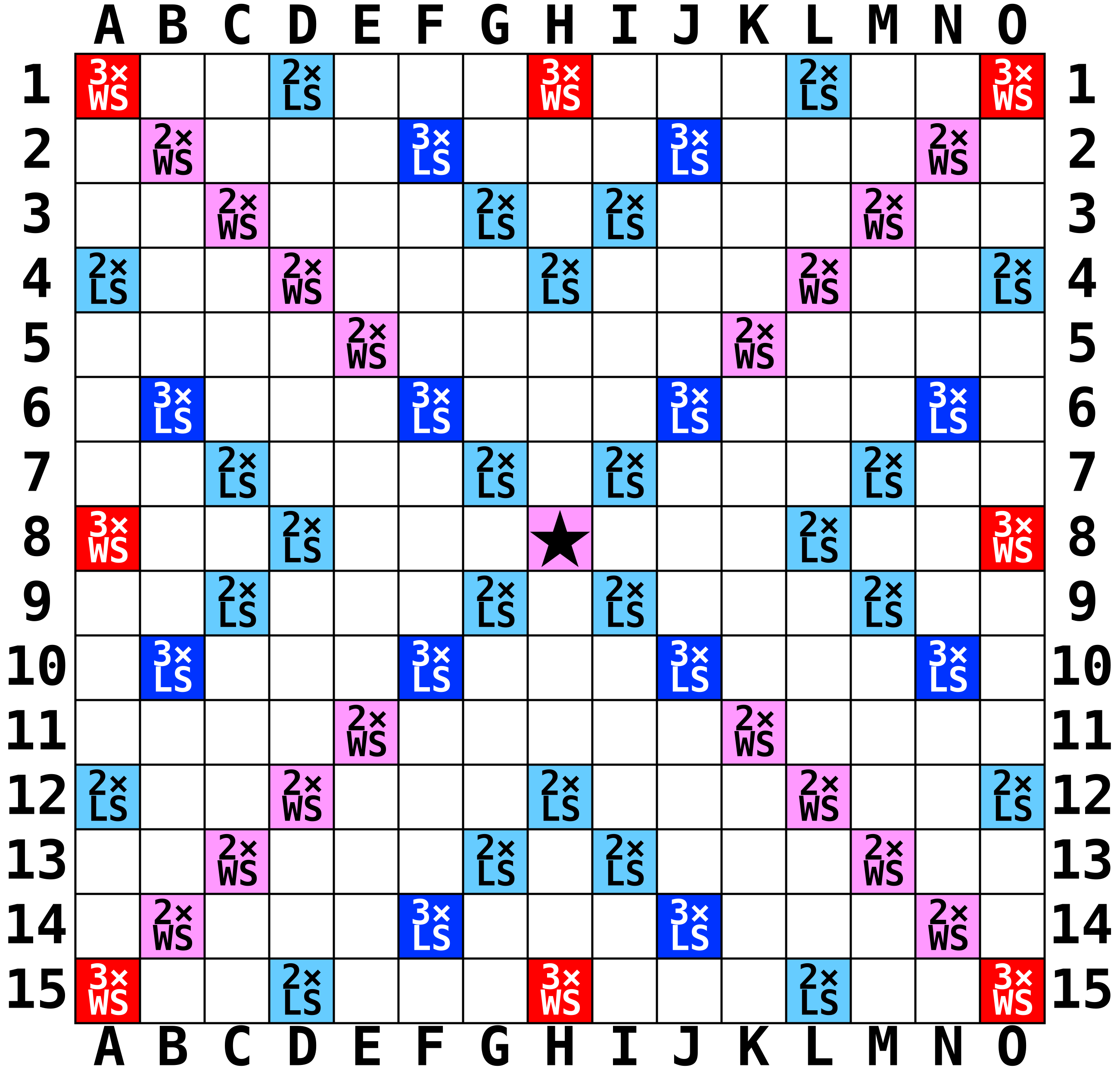
The premium squares
| Square | Count | Effect |
|---|---|---|
| Triple word | 8 | Triples the whole word |
| Double word | 17 | Doubles the whole word. One of them is the centre star, where the first move must start |
| Triple letter | 12 | Triples that one letter |
| Double letter | 24 | Doubles that one letter |
How the multipliers combine
Letter multipliers apply first, then word multipliers apply to the total. If a word covers two double word squares, it is doubled twice — four times the base score. Covering two triple word squares multiplies by nine, which is where the very large scores come from.
A premium square only counts on the turn the tile is placed on it. Playing through a double word square that was already covered gives you nothing extra, which is why the board gets steadily less rewarding as it fills.
What this means for how you play
The premium squares are the whole reason a short word can beat a long one. A three letter word with a J on a triple letter square, placed so the word also sits on a double word square, will usually outscore a seven letter word played on plain squares.
The score calculator lets you check both options before you commit.
Where the premium squares actually sit
The board is symmetrical in both directions, so you only have to learn a quarter of it. Two patterns carry most of the value:
- Triple word squares sit on the outer edge only — the four corners, and the middle of each of the four sides. Every one of them is eight squares away from another along the same line, which is exactly why a long word laid on the edge so often reaches two of them.
- Double word squares run in two diagonals from the centre outward, like a large X. The centre star is one of them, which is why the opening move is always worth double.
The letter multipliers fill the gaps between those two patterns, and the triple letter squares in particular sit three squares in from the edge — close enough to a triple word square that a single high-value tile can reach both patterns at once.
The lanes are what you are really giving away
A useful way to look at the board: forget individual squares and watch the lanes — the rows and columns that lead to a triple word square. If you play a word that ends seven squares from a corner, you have not scored well or badly, you have opened a lane. The opponent needs one word of the right length and the game swings by sixty points.
This is the mechanic behind the advice in our tips article: close the board when you are ahead, open it when you are behind. Closing the board means not leaving a tile within reach of an edge lane; opening it means deliberately doing so because you need the swing.
Words with Friends uses the same size and a different map
The Words with Friends board is also fifteen by fifteen, but the premium squares are in different places, so the intuition you build on a Scrabble board does not transfer. The tile values are different too — twelve of the twenty six letters are worth a different number of points. Both differences are laid out on the Words with Friends page.
Common questions
Does the first word really get doubled? Yes. The centre star is a double word square, and the first move must cover it, so the opening word is always doubled. It is also why an opening bingo is worth so much.
Can a premium square be used twice? No. It counts only on the turn a tile is placed on it. Later words that run through that square score the letter at face value.
What if one word covers two triple word squares? It is tripled twice — nine times the base score. Those are the moves that decide games, and they are almost always played along an edge.
Does the seven-tile bonus get multiplied by the word square? No. The fifty points are added after every multiplier has been applied, so a bingo on a triple word square is (word × 3) + 50, not (word + 50) × 3.
A note on colours
The colour scheme above is the one used on tournament boards. Hasbro changed the retail colours in 2008 — orange for triple word, red for double word, blue for double letter, green for triple letter. The squares and their values are identical; only the printing differs.